Friday, November 21st, 2025

Replacing animals in science

The UK Government has (11.11.2025) published its strategy for “Replacing animals in science”, to deliver on a key pledge from the Labour Party’s election manifesto to set out a clear plan to reduce and ultimately phase out the use of animals in research.
The Alliance for Human Relevant Science welcomes this turning point in government-led promotion of human-relevant science.

The roadmap: a starting point for change

The government’s strategy sets out a framework for how animal experiments will begin to be replaced in the UK. It introduces a tiered model for prioritising which tests can be phased out first, alongside a series of commitments aimed at supporting researchers, funders, and regulators to adopt non-animal methods.

The government describes this strategy as a beginning, with the long-term goal of eliminating animal use in “all but exceptional circumstances.”

A tiered approach to phasing out animal tests

The roadmap groups animal tests into three categories:

  • Basket 1: Tests ready for rapid replacement
    Includes: pyrogen testing, skin and eye irritation, botox potency tests
  • Basket 2: Tests needing further development
    Includes: forced swim test, fish toxicity, pharmacokinetic studies
  • Basket 3: Tests with no current validated alternatives,
    Includes: fish endocrine disruption tests

Set phase-out targets

The government has committed to specific targets for a number of outdated animal tests, such as:

  • Rabbit pyrogen test: to be phased out by the end of 2025
  • Botulinum toxin potency testing: to be replaced by 2027
  • Forced swim test: no new licences; existing ones expire by 2028

Commitments to support the transition

The strategy also includes a range of supporting actions to help embed non-animal methods across the research system:

  • A new UK Centre for the Validation of Alternative Methods (UKCVAM) by 2026
  • A £30 million preclinical translational models hub to develop human-relevant models
  • ‘Validation Accelerator’ grants to fast-track promising alternatives
  • A public dashboard of key performance indicators from 2026
  • A restart of the public attitudes survey on animal research
  • Foundational training in non-animal methods for early-career researchers
  • Support for funders to scrutinise animal use more rigorously in grant decisions
  • Regular publication of priority areas for alternative methods
  • Encouragement for journal editors to publish studies using non-animal approaches
  • Support the upskilling of regulatory assessors and enable engagement between regulators and companies to support the application of non-animal approaches
  • A cross-governmental Ministerial group on alternative methods, chaired by the Science Minister

Together, these commitments signal a shift in how the UK approaches animal research, but they also highlight where further ambition is needed. Our Alliance and all partner organisations stand ready to help, encourage and support these actions wherever we can to drive progress and increase its scale and speed.

The entirely new tone from government, recognising that: “The benefits to addressing these barriers are far reaching and go beyond replacing the use of animals… delivering both scientific advancements and a meaningful cultural shift in animal use” is refreshing and wonderful to hear.

Celean Camp, Chair of the Alliance and CEO of Replacing Animal Research, says: “We’ve long argued that the replacement of animals in science cannot be driven without proper consideration and integration of issues around the development, validation and uptake of NAMs. I’m delighted to see the serious efforts around cross departmental working and integration of these areas including in this document. This strategy provides a springboard for UK life sciences to go further, faster, and we look forward to supporting funders, establishments, and researchers to put it into action.”

Tuesday, September 2nd, 2025

Please sign our petition

It is wonderful that the government is currently working on a roadmap to phase out animal testing. But if it does not include specific targets and clear timelines, it will not alter the status quo, which is deeply entrenched and resistant to change.
Sign this petition to call for an ambitious and detailed UK roadmap for the phase-out of animal research and testing. This is a once-in-a-lifetime opportunity – we must make sure it really delivers!

Thursday, August 24th, 2023

Utrecht University’s Dr Merel Ritskes-Hoitinga awarded Animal Free Research UK’s Pioneer Medal 2023

Queen Mary University of London’s Dr Adrian Biddle and Sophie O’Kane of Karolinska Institutet recognised in inaugural next generation spotlight awards 
LEADING PROFESSOR of Evidence-Based Transition to Animal-free Innovations of Utrecht University, Dr Merel Ritskes-Hoitinga, has been awarded Animal Free Research UK’s Pioneer Medal 2023.

Now in its second year, The Pioneer Award celebrates the achievements of trailblazing scientists who conduct medical research without the use of animals. Last year the award was accepted by Dr Donald E Ingber of Harvard University.

This year also sees the announcement of two new awards, which shine a light on the next generation of inspiring animal free researchers. Dr Adrian Biddle of Queen Mary University London has been awarded the inaugural Outstanding Scientist 2023, and Sophie O’Kane of Karolinska Institutet is first to be awarded Early Career Scientist 2023.

All three winners will receive a specially commissioned accolade during Animal Free Research UK’s Science Conference, taking place in Cambridge over October 4-5th, and each will deliver a lecture on their pioneering contribution to animal free research.

Announcing the winners, Animal Free Research UK’s Science Director Dr Jarrod Bailey said:

“Dr Merel Ritskes-Hoitinga is an expert in her field, leading the way in enabling the adoption of ground-breaking new technologies that are revolutionising the way we conduct medical research. We are thrilled to name her this year’s Pioneer.

We are also proud to announce two new next generation spotlight awards. Our Outstanding Scientist 2023, Dr Adrian Biddle, has made a notable contribution to the field of pioneering animal-free cancer research at the Blizard Institute, Queen Mary University London, inspiring countless young scientists to follow in his footsteps. Early in her profession, Sophie O’Kane is one to watch, her enthusiasm and commitment to pursuing an animal free career shines through in her work to date.”

Pioneer Award Winner, Dr Merel Ritskes-Hoitinga, said: “It is a tremendous honour for me to receive the Animal Free Research UK Pioneer Award. I dedicate my education and research efforts to evidence-based acceleration towards the adoption of animal-free methodologies. This award serves as a motivating force propelling me towards achieving this critical objective, one that holds immense benefits for both animals and humans.”

Outstanding Scientist Winner, Dr Adrian Biddle, said: “I am deeply honoured to win this Animal Free Research award. I have witnessed, over the past decade, the fantastic work that Animal Free Research UK does to raise the profile of animal free research approaches in UK bioscience. It has been really rewarding to have been able to play a role in this. The future of animal free research is certainly bright, and I look forward to a future of technological innovation that enables further replacement of animals in research.”

Early Career Scientist Winner, Sophie O’Kane said: “Words cannot express how it feels to have been awarded the Early Career Scientist Award! To be recognised for something I have found to be as challenging as it has been fulfilling is especially rewarding, and inspires me to call upon all scientists, young and old, to reflect with an open-heart, to embrace novel alternative methods and to join us in the much needed race to replace non-human animals in human medical research.”

Animal Free Research UK CEO, Carla Owen, said: “The Pioneer Awards are a prestigious annual mark of achievement, elevating animal free research and researchers in the scientific community and inspiring the next generation of scientists.  The decisions more and more scientists like Dr Merel Ritskes-Hoitinga, Dr Adrian Biddle and Sophie O’Kane make to champion animal replacement in their work is unlocking answers to the many questions we still have about diseases. Their groundbreaking work deserves to be recognised.”

Monday, August 21st, 2023

Rat Trap was launched in a lively webinar to an international audience of 270, ahead of publication on August 28th.

A fascinating 35 minute presentation, followed by 40 minutes of Q&A.

Monday, July 17th, 2023

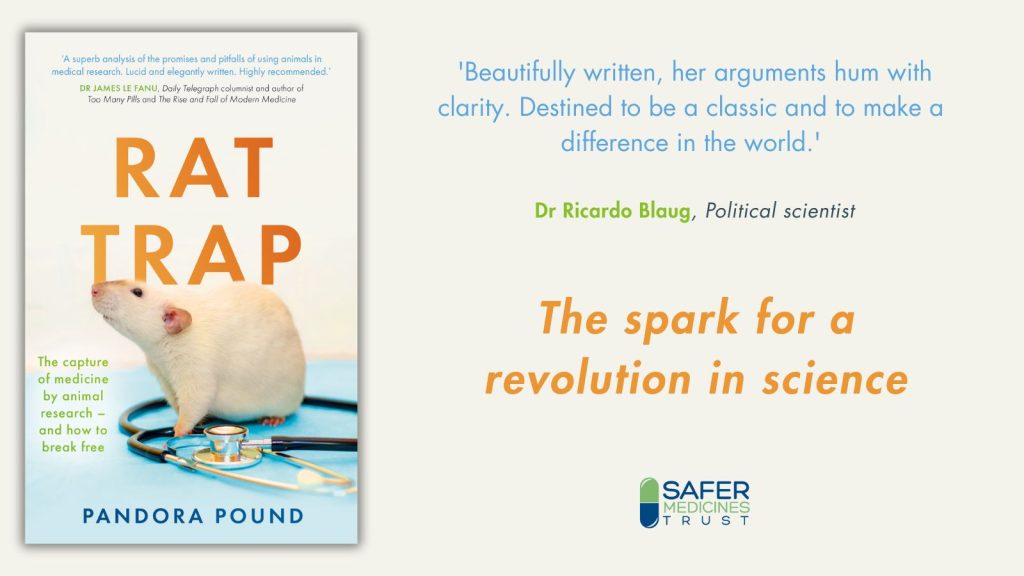
Rat Trap: The Capture of Medicine by Animal Research – and how to Break Free

Dr Pandora Pound, Research Director from Safer Medicines Trust, will be presenting her forthcoming book ‘Rat Trap: The Capture of Medicine by Animal Research – and how to Break Free’ on Monday July 31st at 6pm in a webinar hosted by Kat Herrmann.
In her book, Dr Pound, slays the many myths about animal research and shows that, far from being a necessary evil, it is one of the most important and urgent scientific issues of our time.

The webinar will discuss Dr Pound’s book as well as the difficulties she faced getting it published, throwing light on the challenges of communicating with the general public about the science and replacement of animal research.

Click here to register and find out more: https://www.eventbrite.co.uk/e/book-launch-rat-trap-the-capture-of-medicine-by-animal-research-tickets-635553526707

Tuesday, March 7th, 2023

Proposed framework for integrating human biology-based approaches into drug safety testing

New Approach Methodologies (NAMs) based on human biology have the potential to reduce, and ideally eliminate, toxicities that arise during drug discovery and development. Pharmaceutical companies are already using NAMs in early drug development, with considerable success. However, there are areas of unmet need where NAMs might deliver more predictive power, potentially improving and expediting drug development. At present there is no overarching consensus on how NAMs may be incorporated within regulatory guidelines and numerous hurdles are hampering action. Guidance is needed especially for academic researchers and small biotech start-ups that drive NAM development, yet may be unfamiliar with the precise needs of regulators and other end users.

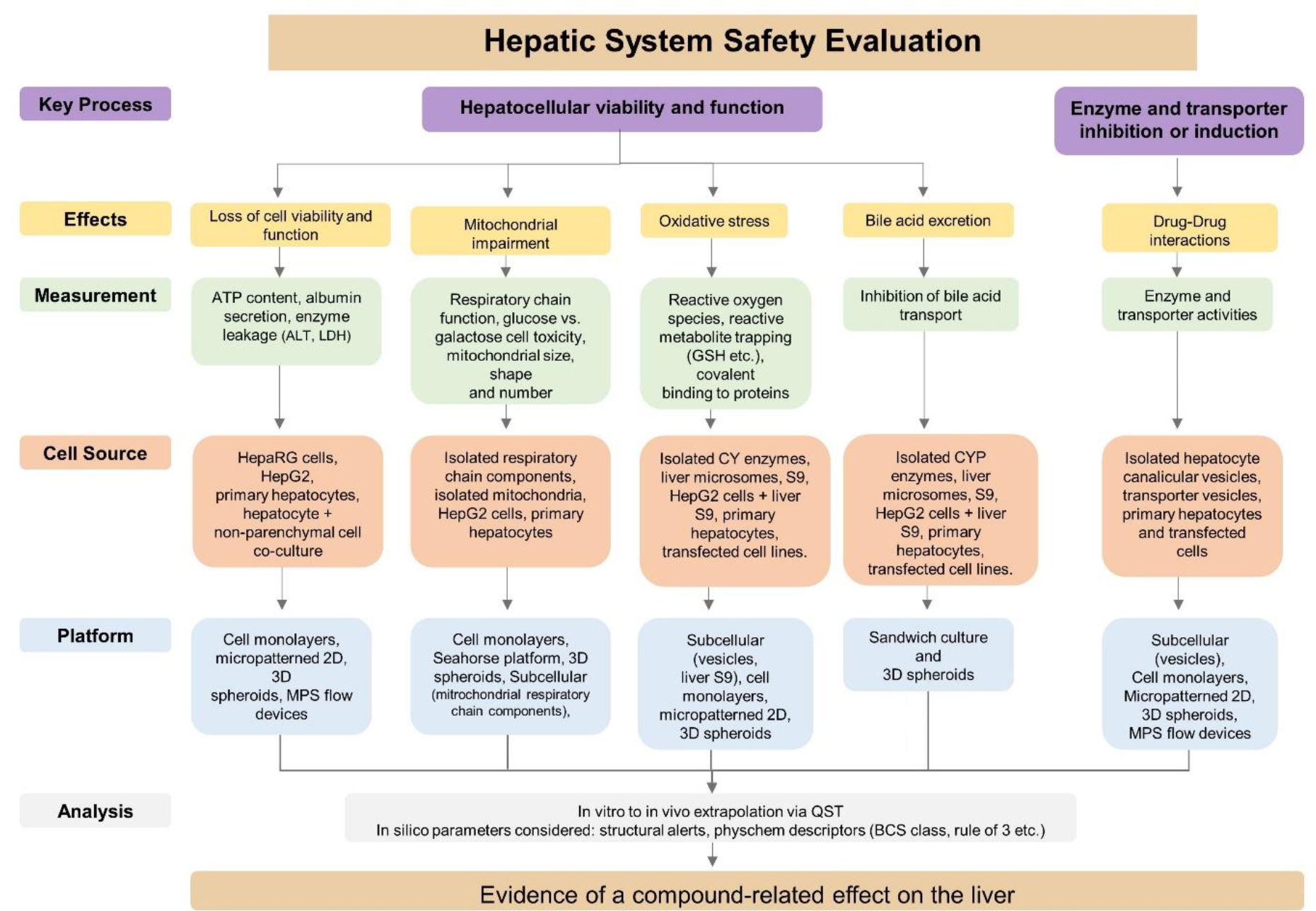
NAMs need to be included within a scientifically valid, integrated human-relevant pharmaceutical safety assessment strategy that will be acceptable to industry and regulators. With this in mind, we held a series of 5 workshops with 13 international experts (regulators, preclinical scientists and NAMs developers), to identify feasible NAMs and discuss how to use them in specific safety assessment contexts.

Participants generated four decision tree ‘maps’ showing how NAMs could be used to assess safety for the liver, respiratory, cardiovascular and central nervous systems. These organ system maps provide guidance on how specific human-relevant tests may be used in each context, as well as a template that could be applied to additional organ systems, or testing in other contexts. Maps like these have potential to guide stakeholders and generate confidence in using NAMs to complement and ultimately replace in vivo animal methods.

Converting these maps into interactive decision trees would allow users to ask specific questions and select the most appropriate NAM for their purpose, so the development of a more dynamic and user-friendly version of these maps is an important project for the future. This work could lead to greater adoption of NAMs, improved pharmaceutical productivity and, most importantly, safer medicines. The findings from this workshop have potential to contribute to implementation of the recently passed FDA Modernisation Act, which enables the use of NAMs for regulatory purposes in the US. We hope others will build on this work and use it to speed the transition to greater human relevance, which is so urgently needed.

Partners from the Alliance for Human Relevant Science included Safer Medicines Trust, Animal Free Research UK and Cruelty Free International. Cruelty Free International conceived the idea for the project and we are grateful to the Cruelty Free International Trust for funding this project and to all participants for so generously giving their time and expertise.

Read the paper in ALTEX here

Tuesday, November 29th, 2022

Accelerating animal-free innovation in the first ever UK Helpathon

FIRST EVER UK HELPATHONLondon recently provided the venue for the very first animal free innovation Helpathon in the UK.
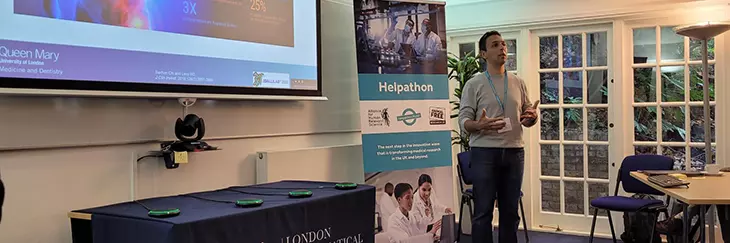
Helpathons are used in the Netherlands to help researchers who might otherwise undertake animal experiments to make the shift towards animal free methods. The idea is that advances in knowledge often happen through chance encounters.  Bringing people together in a Helpathon can tip the odds of those chance encounters in our favour and help to accelerate progress.

TPI Helpathon have organised 6 successful helpathon events so far. We want the UK to join the Netherlands as an international leader in accelerating towards animal free methods. This is why Animal Free Research UK, in collaboration with the Alliance for Human Relevant Science teamed up with the Dutch Helpathon team.

On the first of the two day sprint, the problem to be solved in this Helpathon was introduced by researchers, Professor Jesmond Dalli and Dr Duco Koenis from Barts, the London School of Medicine and Dentistry and Queen Mary University. They wanted help with how to transition their research, which involves using animal models of rheumatoid arthritis, to improved human relevant animal free research methods. Their goal is to test new drug targets for reducing inflammation and bacterial infection in the disease. This will ultimately pave the way for better treatments to resolve inflammation, avoiding irreversible damage and improving patients’ lives.

Ready to capitalise on open minds, open hearts and a great diversity of views thanks to the open invitation, the Helpathon started with Jesmond and Duco presenting an overview of their work with some insightful questioning from the audience, many of whom were non-scientists.

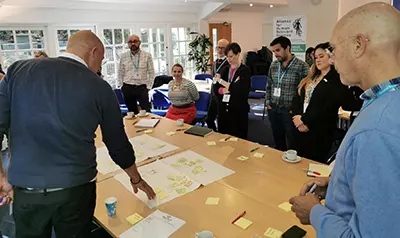
The atmosphere was electric with engaged and inspired participants coming up with questions which were then grouped into themes.  Participants then worked together in rooms discussing and interrogating these questions and moving between rooms, encouraging new connections to be made and more ideas to be generated. Day 2 saw these ideas being released from constraints of reality with visionary thinking around an ’ideal future’ where all research is animal free. Participants worked in teams and transformed themselves into movie makers, actors, comic creators and then live-streamed their final presentations during the closing session. These creative presentations ranged from new methods to help identify drug targets through to roadmaps on how to transition to a future world where science is animal free.
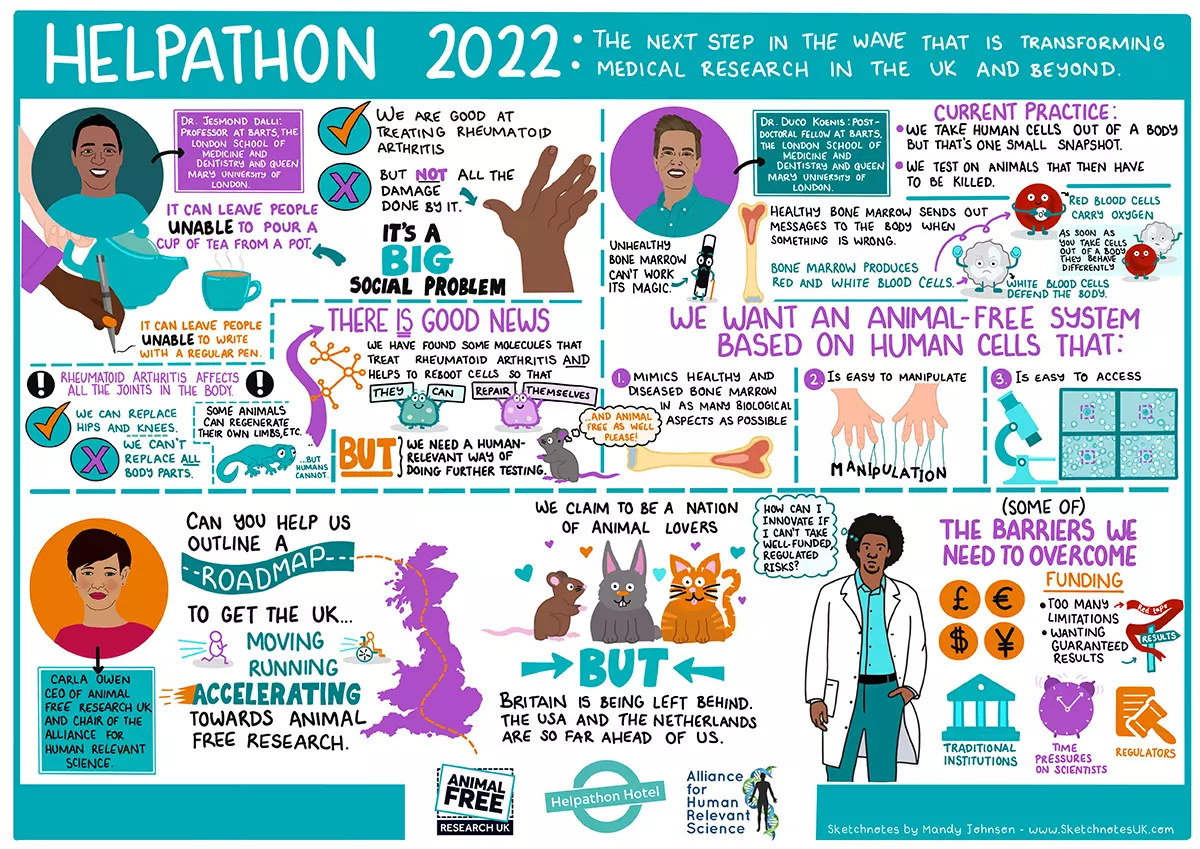

This creativity was captured by a professional doodle artist and a musician who provided inspiration by observing the event and composing a unique piece entitled, ‘there’s science behind kindness’. The event concluded with these ideas being shaped into some tangible ‘takeaways’. This was in the form of letters from participants advising on ‘next steps’ for Jesmond and Duco to take back to their labs, digest and then apply new ways of working to their research.

This pioneering UK Helpathon represents the first step towards the goal of a network of international Helpathons under one umbrella. This would connect collaborators and ideas to each other, helping to create a world where human diseases are cured faster without animal suffering

Carla Owen, Chair of the Alliance for Human Relevant Science and CEO of Animal Free Research UK, said “The arrival of the project in Britain will help the country’s scientists transition away from outdated animal-based medical research methods and grasp a human-relevant future.”

Wednesday, November 2nd, 2022

Cancer Research – a New Paradigm

On 27th October, the Royal Society of Medicine in London was the venue for an exceptionally thought-provoking and inspiring  talk by Dr Azra Raza, Professor of Medicine at Columbia University in New York, international authority on leukaemia, acclaimed author of ‘The First Cell: And the Human Costs of Pursuing Cancer to the Last’ (Amazon’s ‘best science book of the year 2019’) and Science Adviser to Safer Medicines Trust.

Dr Raza’s themes were then eloquently expanded upon by Professor Geoff Pilkington, Emeritus Professor of Neuro-oncology at the University of Portsmouth and former Head of the Brain Tumour Research Centre, Member of the Alliance for Human Relevant Science, Trustee of Animal Free Research UK and The Childhood Cancer Charity and Science Adviser to Safer Medicines Trust.

An expert audience then participated in a Q&A chaired by Dr James Le Fanu, well-known columnist and historian of science and medicine, acclaimed author of ‘The Rise and Fall of Modern Medicine’, Fellow of the Royal Society of Medicine and Patron of Safer Medicines Trust. 

Dr Raza explained why the global cancer research effort should change direction to:
1) focus on prevention and early detection, with the aim of finding the first malignant cell instead of attacking late-stage disease, to which end she has established The Oncology Think Tank and the First Cell Coalition for Cancer Survivors; and

2) focus research exclusively on humans and their tissues, rather than on mice, rats and other animal models. For this purpose, she has founded the First Cell Center, to study her tissue repository of more than 60,000 samples collected from her patients over the past 38 years.

We are so grateful to all the speakers for such an inspirational discussion. The whole event can be viewed below:

Thursday, September 15th, 2022

Join our new community of practice for medical researchers!

A one-of-its-kind online community aimed at improving communication among biomedical scientists has been launched by the Alliance for Human Relevant Science and Animal Free Research UK.

The Animal Free Research Community of Practice is an interactive network for members to share their work, ideas, challenges and passion among likeminded peers.

With free membership for academic and early career scientists, students, industry and other stakeholders involved in biomedical research, members can interact online 24/7 as well as attend planned events, including open houses, roundtables and Helpathons.

A user-friendly website features up to date news, resources, tools, networking and project collaboration opportunities, latest research papers, job vacancies and academic openings. The community is curated by members and hosted by Animal Free Research UK coordinators.

New members can sign up and join the community by clicking here: Join the Community of Practice

Members are invited to create and add content to the online forum, share events and resources, and to collaborate on projects such as writing reviews, articles and much more. The Animal Free Research Community of Practice will bring scientists closer. It will raise awareness, deepen knowledge, drive creativity and spark passion for a science that benefits animals as well as humans.

We urge all who want to practice modern medical research – that which truly delivers benefits for human health – to sign up and become part of this important, exciting community.

Wednesday, June 22nd, 2022

Helpathon: £10,000 available for pilot study grants

Deadline 30 June

The Alliance for Human Relevant Science and Animal Free Research UK are teaming up with members of the Dutch TPI Helpathon initiative to bring the first Helpathon to the UK on 11 and 12 October.

Helpathons are used in the Netherlands to help researchers who might otherwise undertake animal experiments to make the shift towards animal free methods.

The deadline for expressions of interest is 30 June 2022.

Researchers should send a short summary of their research interests and what they would like to achieve from the Helpathon to katharine@animalfreeresearchuk.org

For more information, please visit www.animalfreeresearchuk.org/helpathon