The UK is a world leader in life science research. Yet many breakthroughs are lost in translation from preclinical animal models to humans. There is now a tremendous opportunity to bridge the translational gap with human relevant technologies.
It is time to focus on the human.
The Alliance for Human Relevant Science is an inclusive collaboration of like-minded companies, organisations and individuals. Working together, we will accelerate innovation and create positive change.
Latest
Thursday, February 19th, 2026
Progress in New Approach Methodologies (NAMs) and the human relevant way forward in drug development

Drug development today is hindered by unreliable preclinical models, leading to high failure rates, escalating costs, and a substantial burden of human ill-health, due to adverse effects of prescription drugs and inadequate treatment options for many major diseases.
Significant progress has now been made in developing human-relevant New Approach Methodologies (NAMs) demonstrating predictive power that either matches or exceeds that of animal studies. These advances were discussed and highlighted at a recent Royal Society Science+ meeting titled “A human focus for 21st century life sciences“.
Numerous participants at the meeting described devising human NAMs that have enabled the development of medicines with equal or greater efficacy and safety than animal studies. An important insight emerged: while animal studies have reached a ceiling in their ability to predict human outcomes, NAMs offer significant potential for continuous improvement through evolving technology. It was agreed that a realistic and achievable goal is to develop and implement human NAM-based workflows that can replace animal studies in many areas, thereby improving the efficiency and safety of drug development. Moreover, integrating in vitro and advanced human based AI driven in silico NAMs will provide a robust foundation for next generation medicines with improved safety and efficacy. Additionally, implementing pre-emptive pharmacogenomics will further enhance the safety of marketed drugs.
The use of NAMs outside the regulatory arena, such as in academia and investigative toxicology can and must be prioritised. Funding bodies should invest in NAMs in preference to animals, and compliance with the UK’s Animals (Scientific Procedures) Act 1986 must be enforced regarding the use of available ‘alternatives’, with a much greater focus on avoidance of animal use. We need to generate evidence to support claims about NAMs, benchmarking against human data where possible. Moving forward with NAMs also requires a simple, fast and robust validation process, as well as the synthesis of evidence (e.g. using systematic review methods) to evaluate what works and what does not. Much can be learned from the cosmetics industry which has already switched to NAMs, many of which have benefitted the pharmaceutical and industrial chemical sectors for decades; indeed improved collaboration could be mutually beneficial. We now need to build major international and cross-disciplinary partnerships, involve clinicians, policy makers, regulators, social scientists, philosophers and scientists in academia and industry, and engage with and secure support from the public and relevant stakeholder groups.
Wednesday, February 11th, 2026
Royal Society meeting a great success!
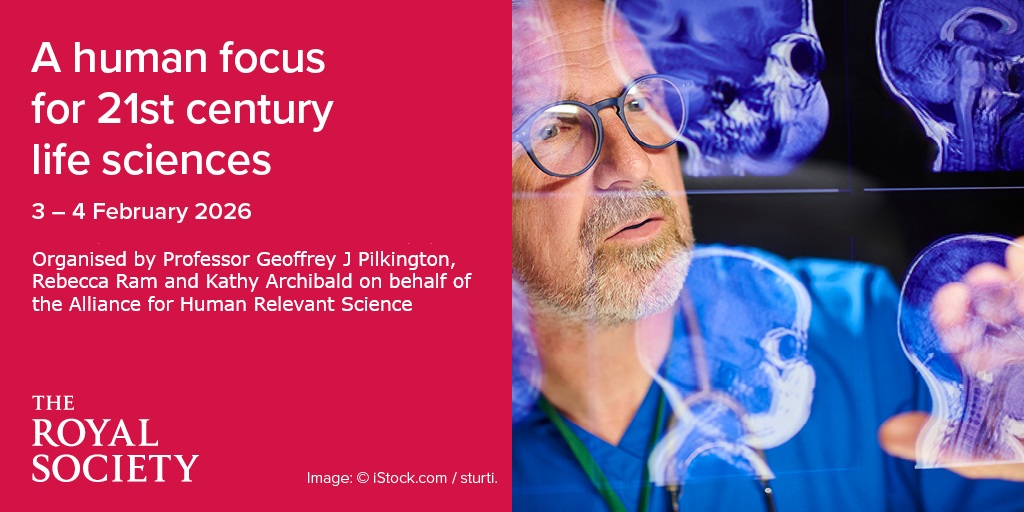 Our 2-day Science+ meeting was an exceptional experience. We were deeply honoured to have so many outstanding speakers, panellists and chairs, which made for riveting discussions and new insights for all.
US FDA Commissioner Dr Martin Makary joined us virtually to talk about modernisation at the FDA, including the move away from animal models to more predictive human-relevant methods. Italy’s Minister of Health spoke about the revolutionary potential of AI and imaging for the future of health care. Professor Denis Noble’s explanation of why we need to rewrite the biology textbooks was a highlight of the meeting.
The meeting was perfectly timed, hot on the heels of strategies from both the UK and US governments to move towards human-focused research, while phasing out the use of animals. Numerous participants described human-based New Approach Methods (NAMs) that they have devised and shown to enable the discovery of efficacious and safe medicines at an equivalent or higher accuracy to animal studies. It was agreed that a realistic and achievable goal is now to devise and implement human NAM-based workflows that can be used in place of animal studies (in many areas), to improve the efficiency and safety of drug development.
Achieving this goal will require major international and cross-disciplinary collaboration. Clinicians, policy makers, social scientists, philosophers, regulators and scientists in academia and industry will be needed. Our meeting was a microcosm of this alliance, with an extraordinary breadth of perspectives in the room and consequently energising discussions and suggestions for solutions.
According to the brilliant Professor Blanca Rodriguez, “hybrid human-based in vitro / in silico systems are ready in many areas. What we now need are the right incentives, regulatory pathways, resources, and training programmes to accelerate uptake…. Human-focused life sciences are moving from vision to implementation.”
The meeting was live-streamed and recorded and we will post the link here as soon as it becomes available at https://royalsociety.org/science-events-and-lectures/2026/02/life-sciences/
Friday, November 21st, 2025
Replacing animals in science
 The UK Government has (11.11.2025) published its strategy for “Replacing animals in science”, to deliver on a key pledge from the Labour Party’s election manifesto to set out a clear plan to reduce and ultimately phase out the use of animals in research.
The Alliance for Human Relevant Science welcomes this turning point in government-led promotion of human-relevant science.
The roadmap: a starting point for change
The government’s strategy sets out a framework for how animal experiments will begin to be replaced in the UK. It introduces a tiered model for prioritising which tests can be phased out first, alongside a series of commitments aimed at supporting researchers, funders, and regulators to adopt non-animal methods.
The government describes this strategy as a beginning, with the long-term goal of eliminating animal use in “all but exceptional circumstances.”
A tiered approach to phasing out animal tests
The roadmap groups animal tests into three categories:
- Basket 1: Tests ready for rapid replacement
Includes: pyrogen testing, skin and eye irritation, botox potency tests
- Basket 2: Tests needing further development
Includes: forced swim test, fish toxicity, pharmacokinetic studies
- Basket 3: Tests with no current validated alternatives,
Includes: fish endocrine disruption tests
Set phase-out targets
The government has committed to specific targets for a number of outdated animal tests, such as:
- Rabbit pyrogen test: to be phased out by the end of 2025
- Botulinum toxin potency testing: to be replaced by 2027
- Forced swim test: no new licences; existing ones expire by 2028
Commitments to support the transition
The strategy also includes a range of supporting actions to help embed non-animal methods across the research system:
- A new UK Centre for the Validation of Alternative Methods (UKCVAM) by 2026
- A £30 million preclinical translational models hub to develop human-relevant models
- ‘Validation Accelerator’ grants to fast-track promising alternatives
- A public dashboard of key performance indicators from 2026
- A restart of the public attitudes survey on animal research
- Foundational training in non-animal methods for early-career researchers
- Support for funders to scrutinise animal use more rigorously in grant decisions
- Regular publication of priority areas for alternative methods
- Encouragement for journal editors to publish studies using non-animal approaches
- Support the upskilling of regulatory assessors and enable engagement between regulators and companies to support the application of non-animal approaches
- A cross-governmental Ministerial group on alternative methods, chaired by the Science Minister
Together, these commitments signal a shift in how the UK approaches animal research, but they also highlight where further ambition is needed. Our Alliance and all partner organisations stand ready to help, encourage and support these actions wherever we can to drive progress and increase its scale and speed.
The entirely new tone from government, recognising that: “The benefits to addressing these barriers are far reaching and go beyond replacing the use of animals… delivering both scientific advancements and a meaningful cultural shift in animal use” is refreshing and wonderful to hear.
Celean Camp, Chair of the Alliance and CEO of Replacing Animal Research, says: “We’ve long argued that the replacement of animals in science cannot be driven without proper consideration and integration of issues around the development, validation and uptake of NAMs. I’m delighted to see the serious efforts around cross departmental working and integration of these areas including in this document. This strategy provides a springboard for UK life sciences to go further, faster, and we look forward to supporting funders, establishments, and researchers to put it into action.”
Thursday, October 9th, 2025
Reserve your place at our Royal Society event ‘A human focus for 21st century life sciences’ – 3 -4 Feb 2026
The Alliance is delighted to invite you to an exciting and unique two-day scientific meeting in London on 3rd and 4th February 2026: A human focus for 21st century life sciences
This free event is sponsored by the Royal Society and will be held at One Birdcage Walk.
This “science+” discussion meeting will showcase the transformative value of innovative, human-focused biomedical technologies, which are providing invaluable insights into human diseases and could underpin the development and optimal use of new and repurposed medicines. It will bring together researchers, clinicians, industries, regulators, policymakers and others to discuss key challenges and how to surmount them to accelerate their advantageous development and implementation.
We are looking for your input, for lively discussions and a real exchange of ideas, to make this meeting of minds have tangible impact
To request an invitation to attend the event in person (only 200 spaces!) or register to watch online, please go to the Royal Society event page
We hope to see you there!